

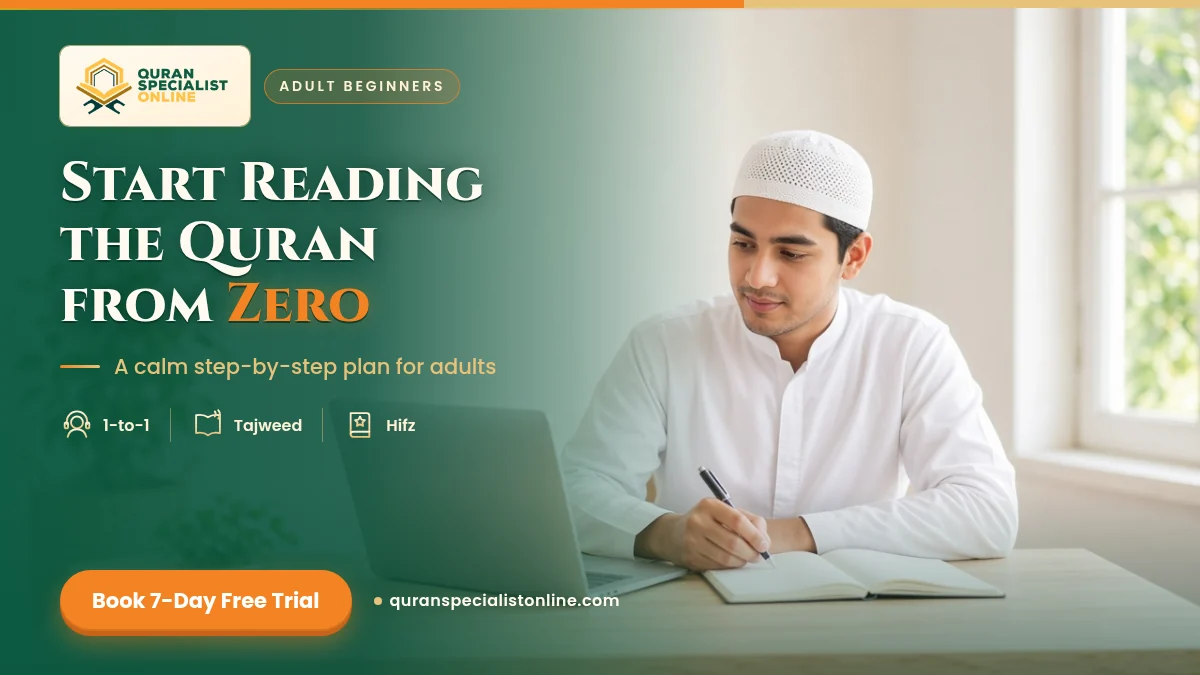
Quick answer: Start with the Arabic letters and their sounds, then learn the vowel marks, then practise joining letters into words. That is what a Noorani Qaida course covers. After that you read short surahs from the mushaf while learning basic Tajweed. A live teacher who corrects your pronunciation from day one, plus ten minutes of daily practice, is the most reliable route for adults.
Written by Quran Specialist Online (QSO).
First, a word of encouragement
If you have never read a word of Arabic, the script can look like a wall of unfamiliar shapes. Plenty of adults feel too embarrassed to start, especially if their children or friends already read. Please do not let that stop you. Every fluent reader once sat exactly where you are.
Allah describes the Quran as made easy to remember and take heed from:
وَلَقَدْ يَسَّرْنَا ٱلْقُرْءَانَ لِلذِّكْرِ فَهَلْ مِن مُّدَّكِرٍ
“And We have certainly made the Qur’ān easy for remembrance, so is there any who will remember?” (Quran 54:17)
Arabic and translation: Quran.com, Sahih International.
And the Prophet (peace be upon him) reassured those who find reading hard that their effort is rewarded:
Narrated Aisha: The Prophet (ﷺ) said, "Such a person as recites the Qur'an and masters it by heart, will be with the noble righteous scribes (in Heaven). And such a person exerts himself to learn the Qur'an by heart, and recites it with great difficulty, will have a double reward."
Sahih al-Bukhari 4937 (Sunnah.com).
So struggling is not a sign that you should give up. It is part of the journey.
The plan at a glance
- Weeks 1–3: the letters and their sounds
- Weeks 3–6: short vowels, then long vowels
- Weeks 6–10: joining letters, sukoon and shaddah
- After the Qaida: reading short surahs from the mushaf with basic Tajweed
These weeks are only a rough guide for someone taking two or three lessons a week and practising daily. Some adults move faster, others slower. Your teacher will set the pace around you.
Step 1: Learn the letters and their sounds
Arabic has 28 basic letters. Some sound like English letters, some have no English equivalent, and a few look alike apart from their dots. At this stage your goals are simple:
- Recognise each letter on sight
- Say each one with the correct sound, from the right place in the mouth or throat
- Notice the pairs that look similar and tell them apart
This is where a live teacher matters most. Reading from an app, it is easy to settle on a sound that is close but not right. A teacher listening one-to-one will hear the difference and correct you straight away. Our guide to makharij (where the letters come from) explains the idea in plain English.
Step 2: Short and long vowels
Written Arabic in the mushaf uses small marks above and below the letters to show the vowel sound. Once you know the three short vowels, you can read any letter with an “a”, “i” or “u” sound. Then you learn how certain letters stretch a vowel into a longer sound.
Practise by reading rows of single letters with different vowels, slowly and out loud. It feels repetitive, but it is exactly this repetition that makes reading automatic later.
Step 3: Joining letters into words
Most Arabic letters change shape slightly depending on whether they sit at the start, middle or end of a word. The Qaida introduces these shapes gradually, then adds the signs for a silent letter (sukoon) and a doubled letter (shaddah). By the end of this stage you are reading real words, then short phrases.
Many adults find this the most satisfying stage. Suddenly the page stops being shapes and becomes words you can sound out.
Step 4: Reading from the mushaf
Once you can read joined words steadily, your teacher moves you to the Quran itself, usually starting with short surahs near the end, such as Al-Ikhlas, Al-Falaq and An-Nas. At the same time you begin basic Tajweed: how long to hold a vowel, when to add a nasal sound, and how to stop correctly at the end of a verse. See Learn Quran with Tajweed.
How to practise between lessons
- Little and often. Ten minutes a day is better than an hour on Sunday.
- Read aloud. Your tongue needs the practice, not just your eyes.
- Listen, then repeat. Play a clear recitation of the page you are learning and copy it.
- Revise before you move on. Start each practice session with yesterday’s page.
- Write down your trouble spots. Bring them to your next lesson.
Common worries adults have
“I am too old.”
You are not. Adults of every age learn to read the Quran. What matters is steady practice.
“I will be embarrassed in front of a teacher.”
One-to-one lessons are private and paced for you. A good teacher expects mistakes and corrects them kindly. If you are a woman and would feel more comfortable with a female teacher, female teachers are available.
“I do not have time.”
A lesson is 30 minutes, and you can join on Zoom or MS Teams from wherever you are. Many adults learn before work, at lunch or after the children are asleep.
“Can I just use an app?”
Apps are useful for extra listening and revision. But they cannot hear you. Without someone correcting your sounds, small errors become habits that are hard to undo.
Why a live teacher makes the difference
Reading the Quran correctly is mostly about sound. In a live one-to-one lesson, the teacher hears every letter you say, shows you how to fix it and checks that the fix has stuck. That feedback loop is what moves adults from hesitant to confident.
At Quran Specialist Online, lessons are live, one-to-one and 30 minutes long, taught in English. You receive monthly written progress reports, so you can see exactly what you have covered. Plans start at £30 a month in the UK and $35 a month in the USA for two lessons a week. See our fee page.
Where to go next
- In the USA? Read online Quran classes for adult beginners in the USA.
- In the UK? See online Quran classes for adults in the UK.
- Learning with your children? Our Noorani Qaida UK and Noorani Qaida USA pages explain how children start.
Frequently asked questions
How long until I can read the Quran?
It depends on how many lessons you take and how much you practise. Many adults finish the Qaida and start reading short surahs within months.
Do I need to understand Arabic to read the Quran?
No. Reading and understanding are separate skills. You can learn to read correctly first and study meaning later.
Should I learn transliteration instead?
Transliteration can help for a few phrases, but it cannot show Arabic sounds accurately. Learning the script is worth it.
What do I need for lessons?
Zoom or MS Teams, a quiet space and ideally a headset.
Is there a free trial?
Yes, a 7-day free trial, so you can meet your teacher before you pay.
Take the first step. Book a 7-day free trial and start reading with a teacher who goes at your pace.
Quran Specialist Online (QSO) is run by QURAN SPECIALIST ONLINE LIMITED, Company No. 13343159. UK +44 7883 185250 · USA +1 786 550 3540.
Try a free Quran class
Live one-to-one lessons on Zoom or MS Teams for children and adults in the UK and USA. Book a 7-day free trial, no payment needed.