


If you are a parent in Britain trying to choose between the local mosque madrassah and online Quran classes for kids UK, you have probably already noticed something annoying: most articles declare a winner before they explain the trade-offs. This guide does the opposite.
Neither option is automatically “better. A good madrassah and a good live one-to-one online tutor solve different problems. Many families use both. What matters is matching the format to your child, your week, and your local mosque — then testing any paid online option with a trial that does not ask for a card.
At Quran Specialist Online we teach live 1-to-1 Beginner Qaida, Tajweed and Hifz for kids and adults, with female tutors on request, parents welcome to sit in, UK plans billed in GBP (£), and a 7-Day Free Quran Trial with no payment or credit card. We will say where online helps — and where the madrassah still wins.
What UK parents are usually deciding between
Mosque madrassah / maktab
Typically an in-person group class after school or at the weekend, often attached to a local mosque. Children learn with peers. Group size and teaching quality vary widely from one mosque to another.
Live 1-to-1 online Quran
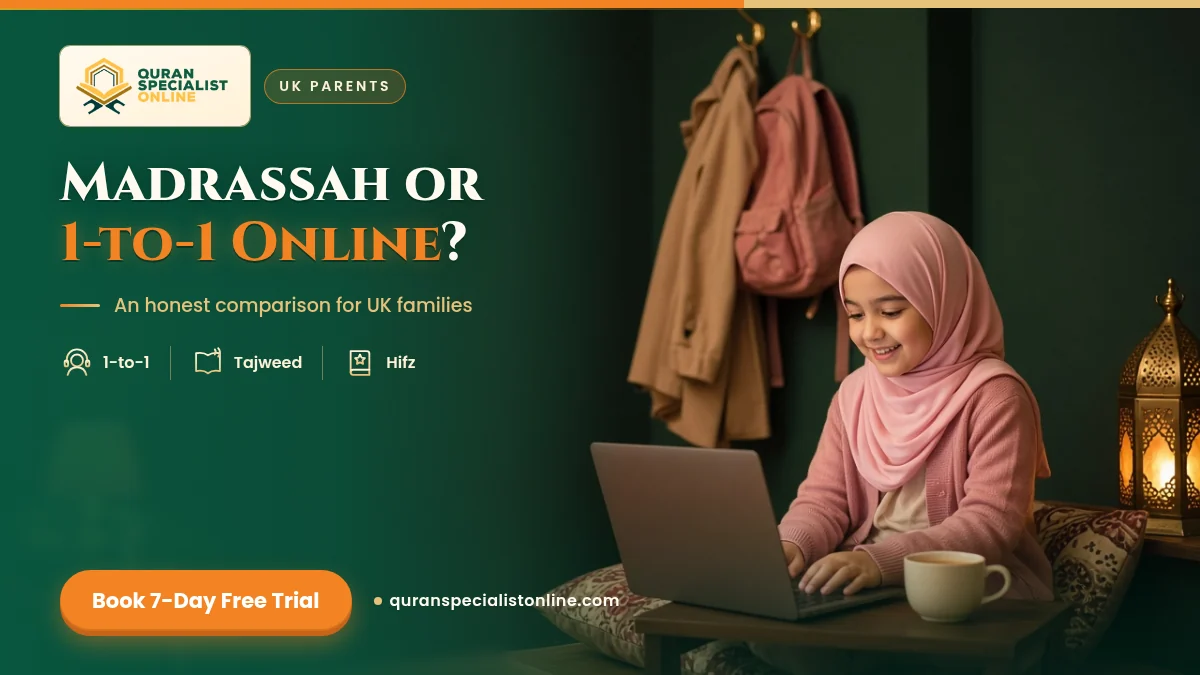
One teacher, one child, on our secure online classroom from home. Lessons are often about 30 minutes. The teacher can correct every letter in real time. Scheduling is usually more flexible than a fixed madrassah slot.
What this article is not
It is not an attack on free or donation-based mosque classes. Community, friendships and a lived Islamic environment matter. Online should be framed as a complement when you need pace, a female teacher, or after-school flexibility — not as a replacement for the masjid.
What a local madrassah genuinely does well
It would be dishonest to skip this list.
- Community and belonging. Your child sits among other Muslim children in a mosque setting. That rhythm is hard to copy on a screen.
- Friendships. Madrassah friendships often reinforce identity for children growing up as a minority in the UK.
- In-person routine. A physical class and a teacher in the room can steady a child who drifts on devices.
- Islamic environment. Adab, du’a and masjid culture are absorbed simply by being there.
- Cost. Many UK madrassahs are free or ask for a modest donation. For a large number of families, that removes money from the decision entirely.
If your local madrassah is warm, well run, and your child is happy there, treat that as a strength — not something to abandon lightly.
Honest limitations of the group madrassah model
These are not reasons to reject every madrassah. They are questions to ask so you know what you are choosing.
- Teacher-to-child ratio. In larger groups, individual recitation time can be short. Quiet children may rarely be heard; small Tajweed errors can linger.
- Fixed pace. Fast learners wait; struggling learners can fall behind without anyone noticing for weeks.
- Travel and tiredness. Weekday evenings after a full school day mean drop-offs and pick-ups across London, Birmingham, Manchester, Bradford, Leeds, Leicester and beyond.
- Variable safeguarding transparency. It is fair — and expected — to ask.
What live 1-to-1 online Quran does well for UK kids
The online models strengths are largely the mirror of group limitations.
- Personalised pace. The whole lesson is your child’s. Letters, joining, and Tajweed rules are corrected in the moment.
- Female tutors on request. Many families want a female teacher for their daughter. Online matching often makes this easier than fixed local staffing.
- No travel. Lessons happen from your front room — useful in term time when everyone is already tired.
- Flexible after-school and weekend slots. Sessions can sit around clubs, homework and Maghrib routines; rescheduling is usually easier than moving a mosque timetable.
- Visible progress. A one-to-one teacher can track exactly where your child is. At Quran Specialist Online, families also receive progress reporting as part of ongoing study.
Path options stay clear: Beginner Qaida → Tajweed → Hifz / Quran memorisation.
Honest trade-offs of learning Quran online
Online is not a free lunch.
- It is still screen time. A live tutor is not a passive app — but it is still a device. Many parents are trying to reduce screens overall.
- You need a quiet corner and a working connection. Tablet or laptop, headphones if the house is noisy, and a calm spot matter more than fancy software.
- Less peer community. One-to-one does not replace mosque friendships. That gap is real.
- Home follow-up helps. Between lessons, a little encouraged practice keeps momentum. The tutor cannot do everything in one short session a week.
If your week truly cannot support any home follow-up, the structure of a strong in-person class may serve your child better — or a hybrid may be wiser than “online only.”
Cost in the UK — keep it in pounds
Speak about UK fees in GBP (£) only.
- Mosque madrassahs: often free or donation-based; some charge modest monthly amounts that vary by mosque.
- Private home tutors: commonly priced per hour (local rates vary).
- Live 1-to-1 online academies: typically monthly plans based on lessons per week.
At Quran Specialist Online, UK students are billed in GBP. UK plans start from £30 per month for live ~30-minute 1-to-1 lessons (see the live fee page for the plan you are considering). Always confirm the current schedule before you enrol.
Trust filter: be wary of any “free trial” that quietly requires a credit card “for verification.” Quran Specialist Online’s 7-Day Free Quran Trial needs no payment and no credit card.
Safeguarding questions every UK parent should ask (madrassah or online)
Ask the same seriousness of both formats:
- Who teaches my child, and how were they screened?
- Is there a written safeguarding approach I can read?
- Can I sit in on lessons?
- How are progress and concerns reported to parents?
- What happens if a teacher is a poor fit?
For online lessons with Quran Specialist Online: parents are welcome to sit in; female tutors are available on request for children and sisters; lessons are live 1-to-1 (not a large unsupervised group chat). Prefer the phrasing Qualified & Experienced Female Quran Teachers when you describe what you want — focus on patience with children, clear Tajweed correction, and transparent communication.
Which option fits which family? (decision framework)
- Madrassah-first if your child thrives on peers, you value mosque community highly, a good local class exists, and cost is decisive.
- 1-to-1 online-first if your child needs individual attention, has fallen behind or raced ahead, you want a female teacher for your daughter, travel is a genuine strain, or no suitable madrassah is nearby.
- Hybrid (very common) — weekend madrassah for community + one or two short weekday online sessions for focused Tajweed or memorisation.
- Trial before you commit — especially for paid online. Use a no-card trial and sit beside your child for the first lessons.
How a typical Quran Specialist Online week looks for a UK child
- Book the 7-day free trial — share age, level, and preferred UK times.
- Attend live 1-to-1 lessons (typically about 30 minutes) on our secure online classroom during the trial window.
- Sit in if you wish; request a female tutor if that is important for your family.
- On day 8, continue on a monthly UK (£) plan — or simply stop. No card was taken for the trial.
Children can often start from around age 4, with pace matched to attention span. Adults in the same household can enrol on a separate path if they wish.
A week-in-the-life comparison (UK term time)
Imagine a Year 3 child in Birmingham or East London.
Madrassah-heavy week: School ends, quick snack, drive or walk to the mosque, 60–90 minutes in a group, home late, homework still waiting. Community time is real. Individual Tajweed minutes may be few.
Online 1-to-1 heavy week: School ends, 30-minute live lesson at the kitchen table, parent nearby for the first month, then a short practice of the two lines the teacher marked. No travel. Less peer company unless you keep weekend madrassah.
Hybrid week (often the calmest): Saturday morning madrassah for friends and masjid rhythm; two weekday online sessions for letters or Tajweed that need a full adult ear. This is not “failing at either. It is using each format for what it does well.
When you read marketing that says online is always “3x faster,” translate it to something measurable: more minutes of your child being heard. That is the real lever — not the video app itself.
City notes without pretending every mosque is the same
Parents searching “Quran classes London online,” Birmingham, Manchester, Bradford, Leeds, Leicester, Luton or Glasgow are often solving a logistics problem, not abandoning the local Muslim community. Dense cities can still mean long bus rides across rush hour. Smaller towns may have fewer female teachers or no Hifz lane for girls.
Online 1-to-1 does not care which postcode you are in, but it still needs a quiet corner and a parent who can champion the habit. If your mosque programme is excellent, keep it. If waiting lists are long or the group is too large for your child’s confidence, a trial online week is a low-risk experiment — especially when no card is required.
What to practise between lessons (10-minute rule)
Whether you choose madrassah, online, or both, progress usually follows tiny habits:
- Same seat, same time cue (after snack, before screens).
- Open only the page or lines the teacher assigned.
- Child reads aloud; parent listens for the two focus sounds.
- Stop while it is still going well — end on success.
- Note one question for the next live lesson.
This is enough for most primary-age children. Over-long home drills create dread. Your tutor should prefer consistency over heroic weekends.
How Quran Specialist Online positions beside — not against — the mosque
We will not tell you to leave a healthy madrassah. Our UK page is for families who need live 1-to-1 Qaida, Tajweed or Hifz with flexible UK times, female tutors on request, and a trial that does not hold a card. If your child’s heart lights up at the mosque, protect that. If their Tajweed needs an adult ear twice a week, add that. The goal is a child who loves the Quran and keeps going — not a brand win.
FAQ (UK parents)
Is online better than madrassah for Quran?
Neither is universally better. Online 1-to-1 usually wins on personal correction and scheduling; madrassah usually wins on community and (often) cost. Many UK families combine both.
What age can my child start online Quran classes in the UK?
Around age 4+, depending on focus. Short lessons and a parent nearby help younger children.
Can I get a female Quran teacher for my daughter?
Yes — at Quran Specialist Online, female tutors are available on request.
Do I need a credit card for the free trial?
No. The 7-Day Free Quran Trial requires no payment and no credit card.
How long should a child’s lesson be?
About 30 minutes is a common sweet spot for school-age children; your tutor can advise.
Where do I see UK fees?
See our fee page (GBP for UK students).
Next step
If you want to test live 1-to-1 without risk, book the 7-Day Free Quran Trial — no payment, no credit card — and read the UK classes page for timings and paths. Keep your local madrassah if it is serving your child’s heart and friendships; add online where you need focus.
Try a free Quran class
Live one-to-one lessons on Zoom or MS Teams for children and adults in the UK and USA. Book a 7-day free trial, no payment needed.