

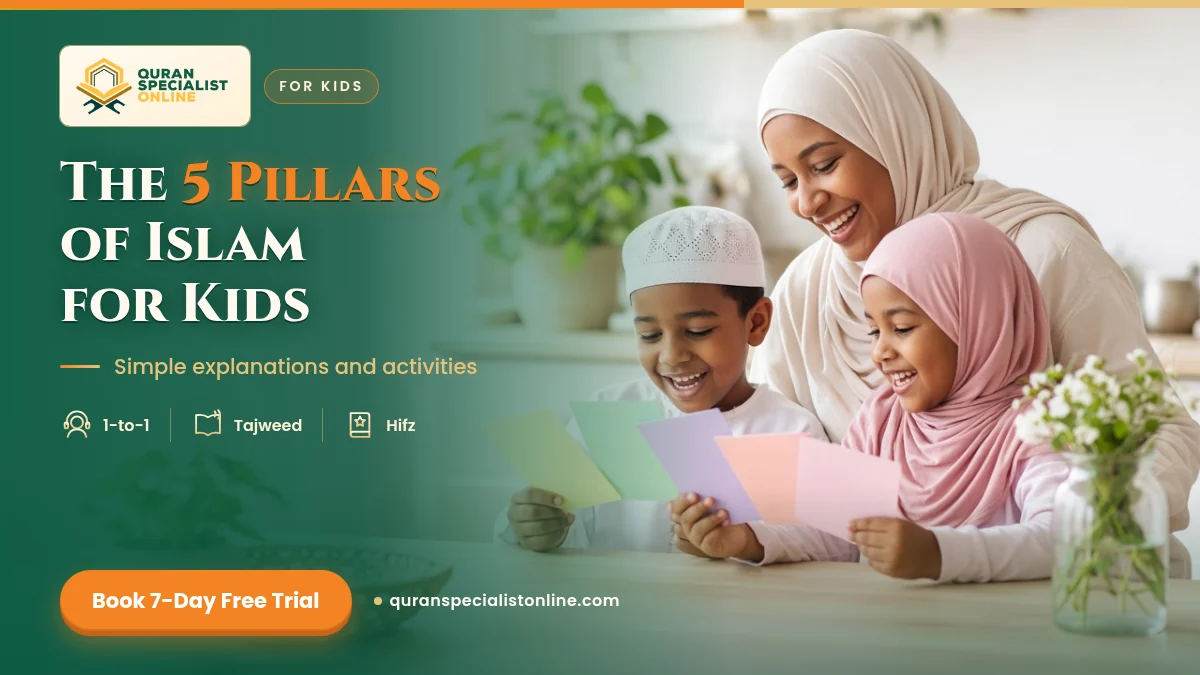
Quick answer: The five pillars of Islam are the Shahadah (declaring faith), Salah (prayer), Zakah (charity), Sawm (fasting in Ramadan) and Hajj (pilgrimage to Makkah for those able). The Prophet (peace be upon him) described Islam as being built on these five. For children, the easiest way to explain them is with the picture of a building: the pillars hold everything up. Below are simple explanations, the Quran and hadith behind each, and one activity per pillar you can do at home.
Written by Quran Specialist Online (QSO).
Where the five pillars come from
The five pillars are listed together in an authentic hadith:
Narrated Ibn 'Umar: Allah's Messenger (ﷺ) said: Islam is based on (the following) five (principles): 1. To testify that none has the right to be worshipped but Allah and Muhammad is Allah's Messenger (ﷺ). 2. To offer the (compulsory congregational) prayers dutifully and perfectly. 3. To pay Zakat (i.e. obligatory charity) . 4. To perform Hajj. (i.e. Pilgrimage to Mecca) 5. To observe fast during the month of Ramadan.
Sahih al-Bukhari 8 (Sunnah.com).
For a young child, you might say: “Islam is like a house. A house needs strong pillars so it does not fall down. These five things are the pillars of our faith.”
A simple way to explain them
| Pillar | What it means | A child-friendly line |
|---|---|---|
| Shahadah | Declaring faith | “We believe there is only one God, Allah, and Muhammad is His Messenger.” |
| Salah | The five daily prayers | “We talk to Allah five times every day.” |
| Zakah | Giving charity from our wealth | “We share what Allah gives us with people who need it.” |
| Sawm | Fasting in Ramadan | “Grown-ups don’t eat or drink from dawn to sunset in Ramadan, to grow closer to Allah.” |
| Hajj | Pilgrimage to Makkah | “Once in their life, if they can, Muslims visit the Ka‘bah in Makkah.” |
Pillar 1: Shahadah, the declaration of faith
The Shahadah is the statement that there is no god but Allah and that Muhammad (peace be upon him) is His Messenger. It is the foundation for everything else.
For children: explain that saying the Shahadah means believing in one God and following the Prophet’s example. Children can learn the words by heart. Ask your child’s Quran teacher or imam to check the pronunciation.
Activity: make a “one Allah” nature walk. Collect leaves, stones or flowers and talk about how one Creator made them all.
Pillar 2: Salah, prayer
The Quran repeatedly instructs believers to establish prayer and give charity, often in the same breath:
وَأَقِيمُوا۟ ٱلصَّلَوٰةَ وَءَاتُوا۟ ٱلزَّكَوٰةَ وَٱرْكَعُوا۟ مَعَ ٱلرَّٰكِعِينَ
“And establish prayer and give zakāh and bow with those who bow [in worship and obedience].” (Quran 2:43)
Arabic and translation: Quran.com, Sahih International.
For children: salah is our special time with Allah, five times a day. Younger children can join in; from around seven, parents begin teaching it properly. Our guide on teaching kids salah walks through it step by step.
Activity: make a prayer-time chart for the fridge with the five prayers and a sticker for each one your child joins.
Pillar 3: Zakah, charity
Zakah is a set portion of savings given each year to those in need, by adults whose wealth reaches a certain amount. Children are not usually the ones who calculate it, but they can learn the value behind it: sharing and caring for others.
For children: “Allah gives us everything we have. Zakah means sharing some of it so everyone is looked after.” You can also explain sadaqah, voluntary charity that anyone can give at any time, even a smile.
Activity: a family charity jar. Children add a coin when they can, and decide together where the money goes at the end of the month.
Pillar 4: Sawm, fasting in Ramadan
يَـٰٓأَيُّهَا ٱلَّذِينَ ءَامَنُوا۟ كُتِبَ عَلَيْكُمُ ٱلصِّيَامُ كَمَا كُتِبَ عَلَى ٱلَّذِينَ مِن قَبْلِكُمْ لَعَلَّكُمْ تَتَّقُونَ
“O you who have believed, decreed upon you is fasting as it was decreed upon those before you that you may become righteous -” (Quran 2:183)
Arabic and translation: Quran.com, Sahih International.
For children: fasting is about patience, gratitude and remembering people who are hungry. Fasting is not required of young children. Even so, lots of them like to try a “half fast” until lunchtime, or joining the family for suhoor and iftar. Speak to a scholar if you are unsure when your child should begin fasting fully.
Activity: a Ramadan good-deeds calendar with one small act of kindness each day. Our article on keeping kids’ Quran lessons going in Ramadan has more ideas.
Pillar 5: Hajj, the pilgrimage
فِيهِ ءَايَـٰتٌۢ بَيِّنَـٰتٌ مَّقَامُ إِبْرَٰهِيمَ ۖ وَمَن دَخَلَهُۥ كَانَ ءَامِنًا ۗ وَلِلَّهِ عَلَى ٱلنَّاسِ حِجُّ ٱلْبَيْتِ مَنِ ٱسْتَطَاعَ إِلَيْهِ سَبِيلًا ۚ وَمَن كَفَرَ فَإِنَّ ٱللَّهَ غَنِىٌّ عَنِ ٱلْعَـٰلَمِينَ
“In it are clear signs [such as] the standing place of Abraham. And whoever enters it [i.e., the Ḥaram] shall be safe. And [due] to Allāh from the people is a pilgrimage to the House – for whoever is able to find thereto a way. But whoever disbelieves [i.e., refuses] – then indeed, Allāh is free from need of the worlds.” (Quran 3:97)
Arabic and translation: Quran.com, Sahih International.
For children: Hajj is a journey to Makkah, made once in a lifetime by Muslims who are healthy and can afford it. Millions of people from every country wear simple white clothes and worship together, which shows that everyone is equal before Allah.
Activity: look at a map together and trace the journey from your home to Makkah. Talk about the people from different countries your child might meet there.
Tips by age
- Ages 3–5: focus on the names and the building picture. Count the five pillars on one hand.
- Ages 6–8: add one simple sentence about each pillar and an activity.
- Ages 9–12: discuss why each pillar matters, and link them to the Quran verses above.
- Teens: talk about how the pillars shape everyday life, from school prayer times to charity projects.
The pillars and Quran learning
Every pillar connects to the Quran. Salah needs Al-Fatihah and short surahs recited correctly. Ramadan is the month the Quran was revealed. Many of the verses above are ones children meet as they learn to read. That is one reason families often pair Islamic studies at home with regular Quran lessons.
At Quran Specialist Online, lessons are live, one-to-one and 30 minutes on Zoom or MS Teams, taught in English. Alongside reading and Tajweed, teachers can talk with your child about the basics of Islam. Parents can sit in, female teachers are available, and you receive monthly written progress reports. Plans start from £30 a month in the UK and $35 a month in the USA, with a 10% discount when more than one family member learns. See the fee page.
Frequently asked questions
What is the difference between the pillars of Islam and the articles of faith?
The five pillars are the main acts of worship. The articles of faith (such as belief in Allah, the angels and the revealed books) are what Muslims believe.
What age should children learn the five pillars?
Children can learn the names from about four. Understanding grows as they get older.
Do children have to fast?
Fasting becomes obligatory at puberty. Younger children may practise if they wish. Ask a scholar for guidance on your child.
Where can my child learn more?
Through regular Quran lessons and Islamic studies. See Quran classes for kids.
Want your child to learn the Quran behind the pillars? Book a 7-day free trial with a teacher who goes at your child’s pace.
Quran Specialist Online (QSO) is run by QURAN SPECIALIST ONLINE LIMITED, Company No. 13343159. UK +44 7883 185250 · USA +1 786 550 3540.
Try a free Quran class
Live one-to-one lessons on Zoom or MS Teams for children and adults in the UK and USA. Book a 7-day free trial, no payment needed.