

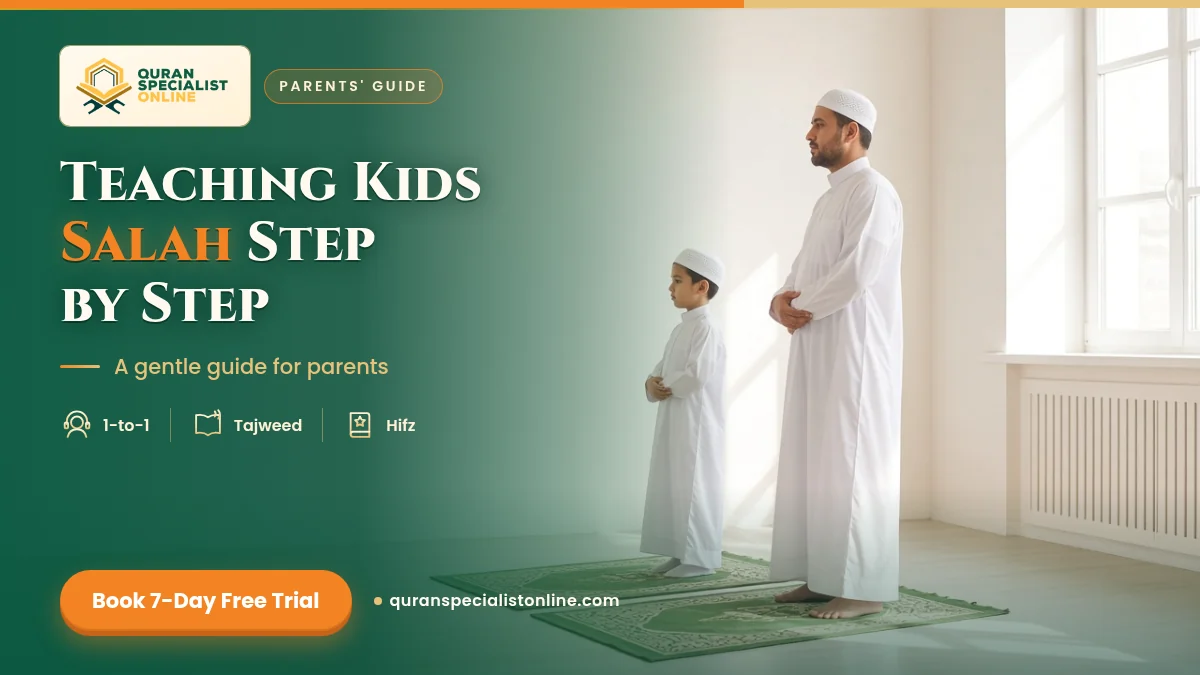
Quick answer: Start early and gently. Young children learn salah by watching and joining in. From around seven, the Sunnah encourages parents to instruct children to pray, so this is a good age to teach the steps properly, one prayer at a time. Teach the movements first, then Al-Fatihah and a short surah, then the remaining words. Keep it warm, praise effort and build up to all five prayers over months, not days.
Written by Quran Specialist Online (QSO). For detailed rulings on salah, please follow the guidance of a qualified scholar or your local imam.
Why teaching salah starts at home
Allah instructs believers to encourage prayer within their families, and to be patient in doing so:
وَأْمُرْ أَهْلَكَ بِٱلصَّلَوٰةِ وَٱصْطَبِرْ عَلَيْهَا ۖ لَا نَسْـَٔلُكَ رِزْقًا ۖ نَّحْنُ نَرْزُقُكَ ۗ وَٱلْعَـٰقِبَةُ لِلتَّقْوَىٰ
“And enjoin prayer upon your family [and people] and be steadfast therein. We ask you not for provision; We provide for you, and the [best] outcome is for [those of] righteousness.” (Quran 20:132)
Arabic and translation: Quran.com, Sahih International.
The Prophet (peace be upon him) also taught by example. When a group of young men stayed with him, he sent them home to teach their families and told them to pray as they had seen him pray:
Narrated Abu Sulaiman and Malik bin Huwairith: We came to the Prophet (ﷺ) and we were (a few) young men of approximately equal age and stayed with him for twenty nights. Then he thought that we were anxious for our families, and he asked us whom we had left behind to look after our families, and we told him. He was kindhearted and merciful, so he said, "Return to your families and teach them (religious knowledge) and order them (to do good deeds) and offer your prayers in the way you saw me offering my prayers, and when the stated time for the prayer becomes due, then one of you should pronounce its call (i.e. the Adhan), and the eldest of you should lead you in prayer.
Sahih al-Bukhari 6008 (Sunnah.com).
For children, “as you have seen me” is the heart of it. They learn salah first by watching you.
A note on age
There is a well-known narration in which the Prophet (peace be upon him) told parents to instruct their children to pray from the age of seven: see Sunan Abi Dawud (Sunan Abi Dawud 495). Seven is therefore a natural point to start teaching salah properly. Before that, simply let children join in as they like. For questions about how this narration is applied, please speak to a scholar you trust.
Stage 1 (ages 3–6): Joining in
- Pray where they can see you. Children copy what is normal at home.
- Give them a prayer mat of their own. It makes them feel included.
- Do not worry about precision. If they bow when you prostrate, that is fine at this age.
- Teach a few short phrases through repetition, such as saying “Allahu Akbar” as you begin.
- Start memorising Al-Fatihah and the three Quls by listening.
Stage 2 (around age 7): Learning the steps
Step 1: Wudu
Teach wudu as a routine in its own right before salah. Do it alongside your child for the first few weeks, naming each step as you go. A simple picture chart in the bathroom helps.
Step 2: The movements
Teach the positions of one rak‘ah in order: standing, bowing, standing up again, prostrating, sitting, prostrating again. Practise the movements without words at first so your child can concentrate on the order.
Step 3: Al-Fatihah
Al-Fatihah is recited in every rak‘ah, so it deserves the most care. Here it is with its meaning:
بِسْمِ ٱللَّهِ ٱلرَّحْمَـٰنِ ٱلرَّحِيمِ
“In the name of Allāh, the Entirely Merciful, the Especially Merciful.” (Quran 1:1)
ٱلْحَمْدُ لِلَّهِ رَبِّ ٱلْعَـٰلَمِينَ
“[All] praise is [due] to Allāh, Lord of the worlds -” (Quran 1:2)
ٱلرَّحْمَـٰنِ ٱلرَّحِيمِ
“The Entirely Merciful, the Especially Merciful,” (Quran 1:3)
مَـٰلِكِ يَوْمِ ٱلدِّينِ
“Sovereign of the Day of Recompense.” (Quran 1:4)
إِيَّاكَ نَعْبُدُ وَإِيَّاكَ نَسْتَعِينُ
“It is You we worship and You we ask for help.” (Quran 1:5)
ٱهْدِنَا ٱلصِّرَٰطَ ٱلْمُسْتَقِيمَ
“Guide us to the straight path -” (Quran 1:6)
صِرَٰطَ ٱلَّذِينَ أَنْعَمْتَ عَلَيْهِمْ غَيْرِ ٱلْمَغْضُوبِ عَلَيْهِمْ وَلَا ٱلضَّآلِّينَ
“The path of those upon whom You have bestowed favor, not of those who have earned [Your] anger or of those who are astray.” (Quran 1:7)
Arabic and translation: Quran.com, Sahih International.
Make sure your child’s pronunciation is checked. Al-Fatihah contains several sounds children often get wrong, such as the throat letters and the heavy letters. Our guide to common Tajweed mistakes children make explains what to listen for.
Step 4: A short surah
After Al-Fatihah in the first two rak‘ahs, a short surah is recited. Most children start with Al-Ikhlas, Al-Falaq or An-Nas. Our memorisation plan for the last 10 surahs gives a gentle weekly routine.
Step 5: The remaining words
Next come the words said in bowing, prostrating and sitting. Teach them one at a time over several weeks, using a source your family trusts, and ask your child’s Quran teacher or imam to listen to their pronunciation.
Stage 3: Building the habit
Once your child knows the steps, the goal shifts from learning to consistency.
- Start with one prayer a day. Many families choose Maghrib, because everyone is usually home.
- Add prayers gradually. Over the following months, add Isha, then Asr, and so on.
- Pray together when you can. Praying in congregation at home is a natural way to keep children involved.
- Use a simple tracker. A chart with a tick for each prayer helps children see their progress.
- Talk about prayer times. Show your child how the times change through the seasons, which is especially noticeable in the UK and northern US states.
Keeping it positive
How children feel about salah matters as much as what they know. Some approaches parents find helpful:
- Praise effort, not perfection. “You remembered every step today” goes a long way.
- Explain why. Older children respond well to simple explanations about talking to Allah five times a day.
- Avoid using salah as a threat or punishment. You want children to associate prayer with peace, not fear.
- Be patient with phases. Most children go through stretches of reluctance. Stay calm and consistent.
Salah at school
For children in UK and US schools, Dhuhr and sometimes Asr fall within school hours, especially in winter. Some schools provide a prayer space. If yours does not, talk to the school calmly about what is possible, and speak to a scholar about how your family should approach missed or combined prayers in your situation.
How Quran lessons help with salah
A child cannot pray well without reciting Al-Fatihah and a few short surahs correctly. That is exactly what early Quran lessons build: correct letter sounds, Tajweed and memorisation of short surahs. Many parents find that once their child’s recitation improves, they are more confident and willing to pray.
At Quran Specialist Online, lessons are live, one-to-one and 30 minutes on Zoom or MS Teams, taught in English. Teachers can focus on Al-Fatihah and the short surahs your child needs for salah. Parents can sit in, female teachers are available, and you receive a monthly written progress report. Plans start from £30 a month in the UK and $35 a month in the USA. See the fee page.
Frequently asked questions
My child is five and wants to pray. Should I stop them?
Not at all. Let them join in happily. Formal teaching can come later.
What if my child keeps forgetting the order?
Practise the movements on their own for a while, and pray next to them so they can follow you.
Should my child understand Arabic first?
No. Teach the words and their meaning in simple English side by side.
Who should check my child’s recitation?
A qualified Quran teacher. See Learn Quran with Tajweed.
Want help with Al-Fatihah and short surahs? Book a 7-day free trial, and a teacher will check your child’s recitation for salah. More: Quran classes for kids UK · Quran classes for kids USA.
Quran Specialist Online (QSO) is run by QURAN SPECIALIST ONLINE LIMITED, Company No. 13343159. UK +44 7883 185250 · USA +1 786 550 3540.
Try a free Quran class
Live one-to-one lessons on Zoom or MS Teams for children and adults in the UK and USA. Book a 7-day free trial, no payment needed.